
Where Do Commercial Applications for Screw Pumps Make the Most Sense?

Reliably moving liquids can be a fairly hard element of commercial operations. Some facilities are working with shear sensitive products, some are working with wastewater with solids, some require to transport vast quantities of water with relatively little lift. Commercial applications for screw pumps can also extend well beyond traditional wastewater infrastructure in these types of scenarios.
The screw pump has a straightforward operating principle and is therefore helpful in a number of sectors. This capacity accommodates varied flow conditions.
Why Screw Pumps Work Well in Certain Commercial Settings
Matching Flow to the Process
A screw pump can be very useful in cases where a facility needs consistent transportation of material without aggressive pumping activity. This is important if the liquid contains particulates or if too much shear could damage the product.
For example, food processors may need to transfer items such as diced vegetables without breaking them up. For beverage producers, equipment capable of handle different viscosities and pressures, but yet providing continuous movement through the process, may also be needed.
That combination makes screw pumps worthy of consideration when part of the pumping requirement is to retain product qualities.
Handling Large Volumes at Low Head
Not every application involves raising water over a great vertical distance. Some facilities just have to transport a large volume from a lower level to a somewhat higher one.
This is one of the situations that screw pumps are particularly well suited to. Modern designs using the Archimedean screw may efficiently handle enormous volumes at low heads, with capacity. That is inherently responsive to incoming flow.
What Is an Archimedes Screw Pump?
A Simple Principle With a Long History
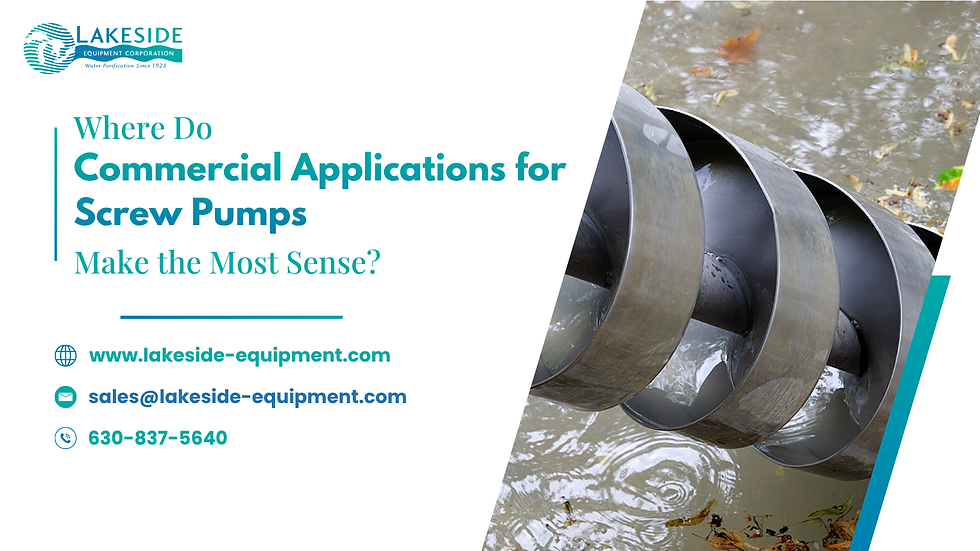
If you've wondered what is an Archimedes screw pump?, the basic concept is straightforward. A helical screw rotates within a trough or housing, lifting liquid as it moves upward along the inclined assembly.
The principle is centuries old and was originally connected with the movement of water for irrigation and drainage. Modern versions employ motors and specialised parts. That is to deliver regulated pumping for industrial and municipal purposes.
Open and Enclosed Designs
Commercial requirements can dictate whether an open or covered layout makes more sense.
Open screw pumps usually incorporate a concrete trough and a geometry around the screw which is accessible. The enclosed variants include a casing with the screw within. Which can result in a more compact installation. The decision is dictated by available space, flow requirements, installation conditions and the material being handled.
Industries Where Screw Pumps Can Be a Strong Fit
Food and Beverage Processing
Food production poses a unique pumping difficulty since the device must transport materials without altering their physical attributes.
Screw pumps are suitable for conveying products such as tomato mixes, curds, whey and other process components in a regulated manner. The constant flow can enable production lines to stay in their planned sequence without over mechanical handling.
Screw pumps are especially helpful in beverage operations for transporting liquids between processing steps. As they can handle varying viscosities and pressures.
Paper and Pulp Manufacturing
Paper mills use significant amounts of water, pulp, chemicals and residual liquids during production. Screw pumps can be used in the transfer of pulp and for separating or conveying liquids at various stages of processing.
Their ability to handle large flows makes them also relevant for effluent streams from industrial activity.
Where Wastewater Applications Stand Out
Screw pumps are one of the most traditional technologies for municipal and industrial wastewater.
Influent and effluent lift stations, return activated sludge systems, stormwater pumping and other treatment applications use wastewater screw pumps. Suitable screw pump designs have non-clogging qualities. That can be helpful if raw wastewater comprises rags, wipes and other detritus.
Return activated sludge is another interesting application. The soft lifting motion minimises disruption of delicate sludge floc as material goes from clarity back to the aeration process.
FAQs
Are screw pumps only used for wastewater?
No. They are used to process food and beverages, make paper, manage storm water, and for irrigation, drainage, industrial operations and recreational water systems.
Why are Archimedes screw pumps useful for wastewater?
Their geometry can accommodate enormous volumes and solids at relatively slow speeds. Open designs also avoid some of the tight clearances of traditional impeller-based pumping systems.
Can screw pumps handle industrial liquids?
Yes, depending on the liquid and operating requirements. Some industrial applications include process liquids where regulated flow and minimal shear are needed.
Conclusion
The most important commercial applications for screw pumps tend to be those involving high-volume movement, relatively modest lift, solids handling or where controlled and predictable flow is important. Food processors, beverage producers, paper mills, wastewater facilities and recreational water activities all have variations of these criteria.
The key to the appropriate selection is the understanding of the operational environment. Screw pump technology can be a suitable solution for demanding commercial and industrial pumping applications, considering flow, lift, space, material characteristics and maintenance requirements.

Comments